
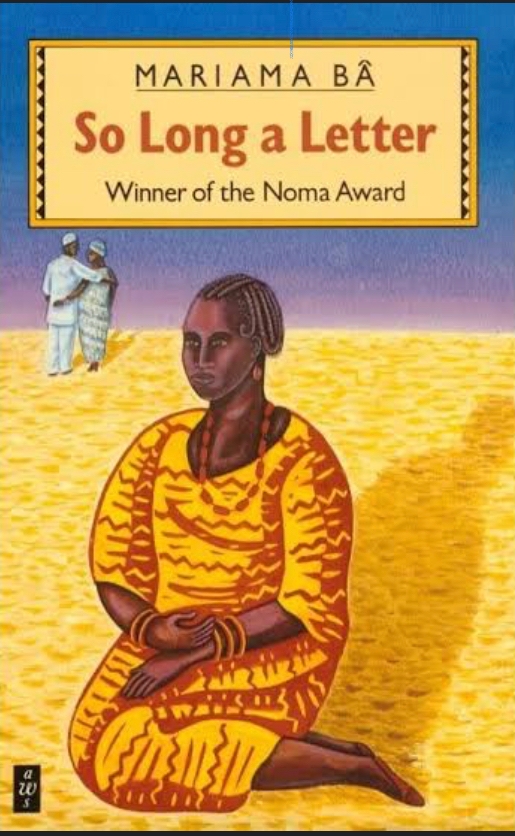
So Long A Letter holds a special place in my literary heart from the first time I read it as a teenager. At that point, it was because it was the first relatable African Muslim women fiction I had ever seen. After a lifetime of reading books about British middle-class boarding schools, snow, Christmas lights and Easter eggs – none of which had any relation to my experience – here was a book in which I recognized the characters, the mannerisms, the beliefs systems. The two main characters could have been my mother and her friends, their husbands could be any of the men I grew up listening to their wives complaints about, and the children – well, those could easily have been me, my friends and my cousins.
Published in 1979, So Long A Letter is a small novella of about 90 pages, said to be a “semi-autobiographical epistolary novel, originally written in French by the Senegalese writer Mariama Bâ”. The book is written as a letter (in a series of entries) from the main character Ramatoulaye to her best friend Aissatou, following the sudden death of Ramatoulaye’s husband. The letter, written while Ramatoulaye is going through ‘Iddah, details her life with her husband, from the beginning of their relationship to his betrayal of a thirty year marriage by secretly marrying his daughter’s school best friend. In this letter, Ramatoulaye details to Aissatou, who experienced a similar marital issue but one dealt with in a different manner years before, how she was dealing with her husband’s betrayal, his death, and with being a single mother of many children.
Re-reading the book in my forties (purely from nostalgia in 2021 when I found it on Scribd) gave me a better appreciation of this classic work. Apart from the African Muslim Women representation (this book is a classic of its genre), its main themes meant it was a no-brainer that I chose So Long A Letter as the first book for the Black (African) Muslim Women Book Club reading lineup.
Personally though, what I enjoyed most about my third reading of So Long A letter (for the BMW Book Club) was the similarity between my Nigerian Muslim culture and the Senegalese Muslim culture. It begs the question, ‘Is there a West African Muslim culture?’ even though our languages vary, based on our colonisers’. Similarities abounded in the rites – not all stemmed from Islam – performed for a dead person, the beliefs and practises, and the societal perception of gender roles. How women are viewed in these societies, probably influenced by the dynamics of an immediate post-colonial society, especially for the first generation of African adults educated in that period was eerily similar. I could recognise many of the attitudes and affect from my parents’ generations in this book.
The major themes of the book are women’s friendships and polygamy. For the latter, the book specifically examines how Muslim men in Senegalese (West Africa?) practice polygamy, and the cultural expectation to the response women have when their husbands venture into polygyny. The central question posed by was: what’s a woman, presumed educated and enlightened, to do when faced with such a circumstance?
We see in the reaction of the main character, Ramatoulaye, and her closest friend, Aissatou, that – more often than not, especially for polygamy done wrong – there are only two choices to be made. To stay, often having to navigate the indignity of the circumstance. Or to leave, often having to face the rancor or censure of the society. Interestingly, more than the question of choices (for me, there is no right or wrong response; every woman will have to make her choice based on her own circumstances, experiences and aspirations) a deeper question the book brings about is one that we’ll need scholars of Islam to answer.
If the right of men to polygamy, granted to them in the Deen, is abused by said men, often leading to an infringement of the women’s rights (also protected by the Deen) is that still islamic polygamy? And/ or what recourse do Muslim women have in such cases?
The second, less obvious, theme that threads through the book, which I love, (in case my book Rekiya & Z is not already a dead giveaway of this) is that of friendship between the two women. From their early life growing up stages as school girls up to their respective marriages, we see how close they are. Women who are fundamentally different, as was obvious in their individual responses to a similar marital challenge. Yet, they continued to hold space for each other and respect each other’s choices, without necessarily projecting their own insecurities or defences on the other.
A final theme that this book brings up for me is the idea of raising daughters, as mothers caught between the intersection of our identities. How do we raise our daughters to get the best of what we hoped for ourselves without stifling their individuality? We see this play out in how R relates first with her first daughter, Daba, who is very clear on her goals/ideas of what a marriage should be and how intentionally she goes after that and creates it in her own union. We see it with R last three daughters, the “problematic” ones who dare to push boundaries their mother held sacrosanct. And we see how, in grappling with all that, R simultaneously leans on while neglecting the “good” daughter, until said daughter crosses the line. I especially appreciated how Rahmatullahi handled her daughter’s unexpected, unmarried pregnancy, displaying an accepting empathy that is surely compulsory when raising teenagers.
In all, So Long A Letter is a small book that encompasses so much of what it means to be an African Muslim woman. Using polygamy as a metaphor, the ending of the book concludes – rightly so – that every woman has to find a way to make happiness for herself, because no one is coming to save us. It’s a definite starting point for anyone wanting to read more about the African Muslim Women experience in fictional accounts.
 Muti'ah Badruddeen